
What is SEO?

A Guide To Search Engine Optimisation
Why do some websites appear on the first page of Google while others never show up at all? The difference, in most cases, is search engine optimisation.
SEO is the work of making a website easy for search engines to find, read and understand, and of demonstrating that it deserves to rank. Done properly, it puts your business in front of people at the exact moment they’re searching for what you offer.
This guide explains how SEO works, what it involves, and what separates the sites that rank from the sites that don’t.
Read More About Our → SEO Case Studies
Peter has been doing our SEO for our website Principal Landscapes for a few years now. Our ranking has always been very good and Peter and his team have worked diligently in the background to ensure our website is first class, functional and has a good presence online. Peter’s always available and has been great to deal with. Highly recommended!
Cullen Long
Principal Landscapes + Pools
principallandscapes.com.au
Where it all began: Internet and Search Engines
In the late 1990s, businesses realised the internet was where their customers were heading, and search engines became the front door.
Early search engines were simple, and early SEO reflected that: pages stuffed with keywords, and sometimes text coloured to match the background so even more keywords could be hidden on the page.
For a while, those tricks worked.
Then search engines got smarter. Google in particular learned to detect manipulation, and the tricks that once lifted rankings began destroying them.
The businesses that lasted were the ones that switched to doing it properly: building genuinely useful sites and earning their positions.
That change set the pattern that still holds today.
Every major Google update since has moved in the same direction, rewarding quality and punishing shortcuts.
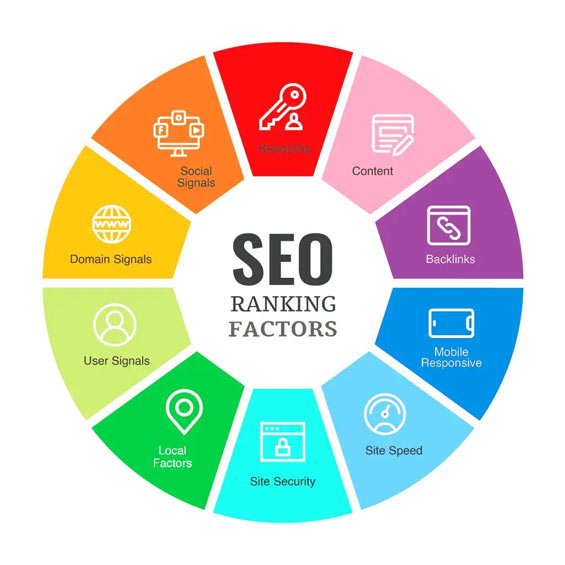
How search engines decide who ranks
Elements of SEO
Several search engines operate worldwide, but Google handles roughly nine out of every ten searches.
For that reason, SEO work is overwhelmingly focused on Google: rank well there and the other search engines tend to follow.
Google’s algorithm weighs hundreds of signals to decide which pages best answer a search, and it changes constantly, with thousands of adjustments made every year.
That’s why SEO is a discipline rather than a checklist: the fundamentals stay stable, but the details move, and staying ranked means staying current.


Understanding Search Engine Results Pages (SERPs)
A search engine results page (SERP) is what Google shows after a search: paid ads at the top, often a map pack for local searches, then the organic results, and increasingly an AI-generated overview above everything.
Position matters enormously.
The overwhelming majority of clicks go to the first few organic results, and very few searchers ever open page two.
In practice, ranking on page one for the terms your customers use is the difference between a website that generates business and one that just exists.
The rise of AI Overviews has raised the stakes further: many searches are now answered on the results page itself.
We’ve published our own analysis of what that change means: two-thirds of Google searches now end without a click.
SEO Is Ongoing Work
SEO is not a project you finish.
Rankings are competitive positions, and competitors, and Google itself, keep moving.
A site that stops being maintained gradually loses ground: content ages, technical standards change, and competitors who keep working move past it.
This is why the strongest results in our case studies come from long-running campaigns.
Our work with Blue Print Homes has run since 2010 and lifted organic traffic 207%. Brilliance Carpet Cleaning has grown 448% across a campaign running since 2016.
Positions like those are built, and held, through consistent work over years, not a one-off optimisation.

The SEO Toolbox: What You Need to Pack
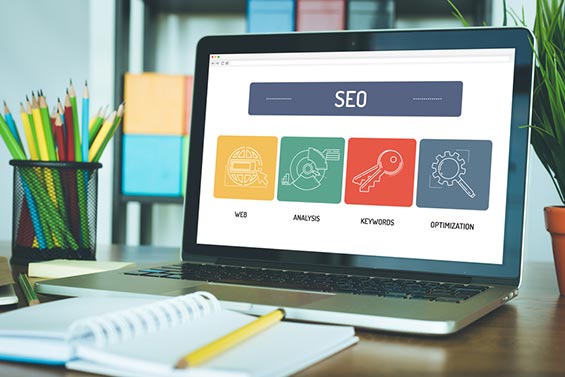
Let’s break down the most essential elements of SEO that can set you up for success:
Keyword Research: What language are customers speaking? What is the collection of words they’re typing into Google in an attempt to find a product or service that you offer?
On-Page SEO: Google is a demanding algorithm that has some premium requirements. You make sure you’re putting all those things on your page (website), and now Google can read it, understand it, and rank it. Read more about On-page SEO
Content Creation: Customers now have really high standards. They need valuable, high-quality information, presented perfectly – otherwise they’ll bounce and click on the next result on a SERP. Give your customers a valuable read. Make it worth their time. Read more about content creation.
Link Building: Get reputable sources of information to link to your site, and it serves as a testimonial for the Google algorithm. “Hey, this site is legit. Bring it up on search results.” Read more about link building.
Technical SEO: This is backstage tech stuff that needs to be set up. Basically making sure your website is fast, user friendly, works on all devices, and is secure – the boring but important stuff. Read more about SEO audits
Local SEO: If your business has a physical presence, you implement local SEO to show up on search results for Google searches around you. Say someone types ‘pizza near me.’ If your local SEO is set up, your website will show up on a SERP.
The SEO Audit: Health Check-Up for Your Website
Every serious SEO campaign starts with an audit: a full assessment of the site’s technical health, content, structure and existing rankings.
The audit reveals what’s holding the site back and where the biggest opportunities are, so the work that follows is targeted rather than guesswork.
Audits routinely surface problems the site owner had no idea existed, from slow pages and broken links to structural issues, and occasionally something as fundamental as a site accidentally set to ‘noindex’, which tells Google to ignore it entirely.
Faults like that can silently cancel out everything else a business does online.
Read more about what an SEO audit involves.
SEO Tactics to Embrace and Avoid
SEO strategies fall into two broad camps.
White hat SEO works within Google’s guidelines: quality content, a well-built site, and links earned on merit. It’s slower than the shortcuts, and it’s the only approach that lasts.
Black hat SEO tries to trick the algorithm: keyword stuffing, cloaked text, purchased links and private link networks. It can produce short-term gains, and it reliably ends the same way, with penalties or removal from the search results altogether. Google has spent two decades getting better at detection, and recovery from a serious penalty is slow and sometimes impossible.
Our position after 20+ years in this industry is simple: we don’t use black hat techniques, for the same reason we advise clients never to, the downside is the business’s entire search presence.


An Eye Into the Future: SEO
The fundamentals of SEO are stable, but the environment keeps changing. The developments that matter most right now:
AI search. Google’s AI Overviews and tools like ChatGPT now answer many questions directly, citing a handful of sources. Being one of those cited sources is a discipline of its own, covered by our Generative Engine Optimisation (GEO) service.
Mobile-first. Google predominantly judges the mobile version of your site. A site that works poorly on a phone is fighting with one hand tied.
User experience. Google measures how people interact with your site: whether pages load fast, whether visitors find what they came for, whether they stay. Sites that serve visitors well are rewarded; sites that frustrate them slide.
Voice and conversational search. More searches are phrased as natural questions, which changes the keywords worth targeting and the way content should answer them.
What SEO Delivers: Real Results
The clearest way to show what SEO can do is with real campaigns.
A few from our published case studies:
- Perth Landscapes: 1,460% increase in organic traffic, holding the top of one of Perth’s most competitive local markets.
- Communikids Speech and Language: 556% increase in organic traffic for a Perth allied health practice.
- Rowe Bristol Lawyers: 178% increase in organic traffic, with “Construction Lawyers Perth” and “Corporate Lawyer Perth” both reaching number one.
- Land Surveys: 231% increase in organic visitors across a national, multi-state campaign.
Every one of these is documented in full, with the keywords, timeframes and numbers, in our SEO case studies.


Getting Started With SEO
SEO rewards patience and punishes shortcuts.
It means understanding what your customers search for, building a site that deserves to rank, and keeping at it while the results compound. Done properly, it becomes the most cost-effective source of new business a website can have.
You can do it yourself with time and persistence, or hand it to people who do it every day.
Either way, the starting point is the same: knowing where you stand now.
Talk to us about a free SEO audit and quote, and we’ll show you exactly where your website sits and what it would take to move it.
FAQ’s
Q: What is link juice?
A: Also referred to as ‘link equity’ in some SEO circles, link juice is the amount of power or authority that a link transfers from the page it is placed on to the page that it links to.
This means that if you have a link from a high-authority website, some of that website’s clout passes to yours.
This is why links from high-ranking websites are so desirable, and as you’d expect, more difficult to obtain.
Q: What is anchor text?
A: Whenever you create a backlink, you can have it appear simply as the raw URL like this: ‘https://mywebsite.com’.
There are many reasons why this is desirable, including wanting to avoid over-optimisation.
Google gets suspicious when all it sees is anchor text in backlinks so using a fair amount of links that are just the URL helps deal with that.
When you use anchor text, instead of seeing the raw URL, a piece of text is seen, and it is usually a different colour to the text around it. This text is usually a keyword or keyword phrase that you want to rank for.
Q: What is HTTPS and does it affect SEO?
A: When you visit a website, if you look at the URL bar, you will normally see either ‘HTTP’ or ‘HTTPS’ at the start of the domain name.
These stand for Hyper Text Transfer Protocol, and the ‘S’ stands for Secure.
If a website domain has the secure version HTTPS it means that the website owner has acquired a certificate that authenticates the website, and that the privacy and integrity of any data which is exchanged with website should be secure.
With most internet users having a heightened awareness of online security, and the risks of data breaches, Google took the decision to give greater prominence to a website with HTTPS as opposed to one with HTTP.
As obtaining HTTPS certification is relatively easy and inexpensive it is certainly worth doing so, not least because of the SEO implications.
Q: How do I conduct keyword research?
A: Keyword research can be a time-consuming task if you’re not familiar with the process, especially considering the vast number of potentially relevant terms within your industry.
Many Perth businesses choose to partner with an SEO agency to handle this crucial work.
Professional SEO experts in Perth use specialised tools and software to identify popular search terms within your niche.
These tools allow them to analyse not just search volume but also the level of competition trying to rank for each keyword in the Western Australian market.
Drawing on their experience, a reputable SEO company can pinpoint which keywords offer the best opportunities, those with decent search volume but lower competition that are easier to rank for.
They’ll also identify more competitive terms that might require a longer-term strategy.
This balanced approach helps create an effective SEO plan aimed at ranking for the optimal mix of keywords.
Q: Where should keywords be used on my website?
A: There are various places on your website that keywords can be used, and it is important to know that there is a hierarchy, meaning certain places are given more credit by Google than others.
In descending order, they are the domain name, link anchor text, inner URL, title tag, meta description, and content. The principle behind this is that Google sees these in order of difficulty in terms of being able to get links, with a domain name being the most difficult and content being the easiest.
As you optimise and grow your website you can use keywords in the places we have just mentioned, but do not overdo it, especially in your written content.
This is where many business owners mess up the SEO of their website, because they overuse keywords, use them in the wrong places, or both.
Q: How important are SEO meta tags?
A: Meta tags are relatively simple, but that does not mean they are not important for SEO purposes.
They are words used within the code of a website to identify certain parts of it.
When Google spiders your website it reads the meta tags, and one of the benefits of that is that it tells Google what keywords you wish to rank for.
The three most important meta tags are the title tag, which is what people will see when your website appears in the search engine listings, the description tag, which is a summary of what your website is all about, and the keywords, where you can list the keywords relevant to that page.
Q: What’s the difference between internal and external link building?
A: There is often a misconception among those new to SEO that only external links carry any weight, but that is not the case.
In fact, planning and implementing a proper internal linking structure can provide your website with a huge boost to its SEO and subsequently its ranking.
Internal links are those which you link within your website, and this includes links to and from pages, categories, posts, images, and other content.
It is important to note that linking internally cannot be done in a haphazard and random manner, otherwise it has little or no benefit.
External linking is obviously those links which you create on other websites, including social media. One of the main differences with external links is that you have less control over them than you do with internal links.
Q: What is domain authority?
A: Domain authority (DA) is a metric created by the SEO software company Moz that predicts how well a website might rank in search engine results.
For Perth businesses trying to gauge their online strength, it’s a useful benchmark that our SEO experts frequently reference.
To explain it simply, domain authority works similarly to how we might evaluate the standing of professional actors.
Just as actors are judged by their hit films, award wins, and box office takings, websites are assessed through various quality signals.
These include the number and quality of backlinks pointing to your site, plus the growth rate of these links over time.
Moz uses more than 40 different factors to calculate domain authority, resulting in a score between 1 and 100.
The most trusted websites, like major news outlets and government sites, typically score between 90 and 100.
Improving your DA becomes progressively harder as your score increases, moving from 40 to 50 is much more achievable than climbing from 80 to 90.
Many Perth businesses work with an established SEO agency to develop strategies specifically aimed at improving their domain authority, as higher scores typically correlate with better visibility in search results.
Q: What is a Google penalty?
A: A Google penalty occurs when Google identifies a website that has done something which is against its guidelines.
This usually means that the website’s ranking drops massively.
Often this will be due to black hat SEO practices, but it can also occur when the website owner falls foul of a new algorithm update or change in Google’s policies.
Where this will happen is to a website that previously was following accepted SEO practices, but Google changes how it views them.
A famous example of this was the Penguin update, when Google started taking a negative view of sites that had lots of spammy links.
Previously these links were helping rankings, but after this update, sites using them were penalised and dropped down the rankings significantly.
Q: How do I recover from a Google penalty?
A: The first thing is not to panic.
Many Google penalties are temporary and a few simple actions can be enough to reverse them.
These actions can include making a list of all your backlinks, analysing them, and removing or disavowing those which you can identify as being poor quality.
Content can also be an issue, so look at your posts and pages and see where you may have what Google considers thin content, and improve upon it.
Also, make sure you have no scraped or duplicate content.
Keyword stuffing is something which can also bring about a penalty, so any content which has this should be rewritten or removed.
Once you have corrected anything which could be a potential target for a penalty, you can then send Google a Reconsideration Request.
In this, you explain the actions you have taken to put right what was wrong, showing them you have done everything you possibly can to remove, edit or update your website, its content and your linking structure.
It also helps your case if you can show them you have watched specific Google webmaster videos relating to Google’s guidelines.
Q: What is the difference between Follow and No-Follow links?
A: The answer is quite simply that with a follow link, Google is directed to the website that backlink is pointing to, and conversely, with a no-follow link, it is told not to.
Using no-follow links is often done by the owner of the website that the links are on, who does not wish to pass any of the ranking or authority their website has to the sites it links to.
Let’s get started today - and I bet your website will catch up!
Read More About Our → SEO Case Studies