
Two-Thirds of Google Searches Now End Without a Click. Here’s What That Means for Your Perth Business
Rand Fishkin and the team at SparkToro have just dropped a number that should make every business owner sit up.
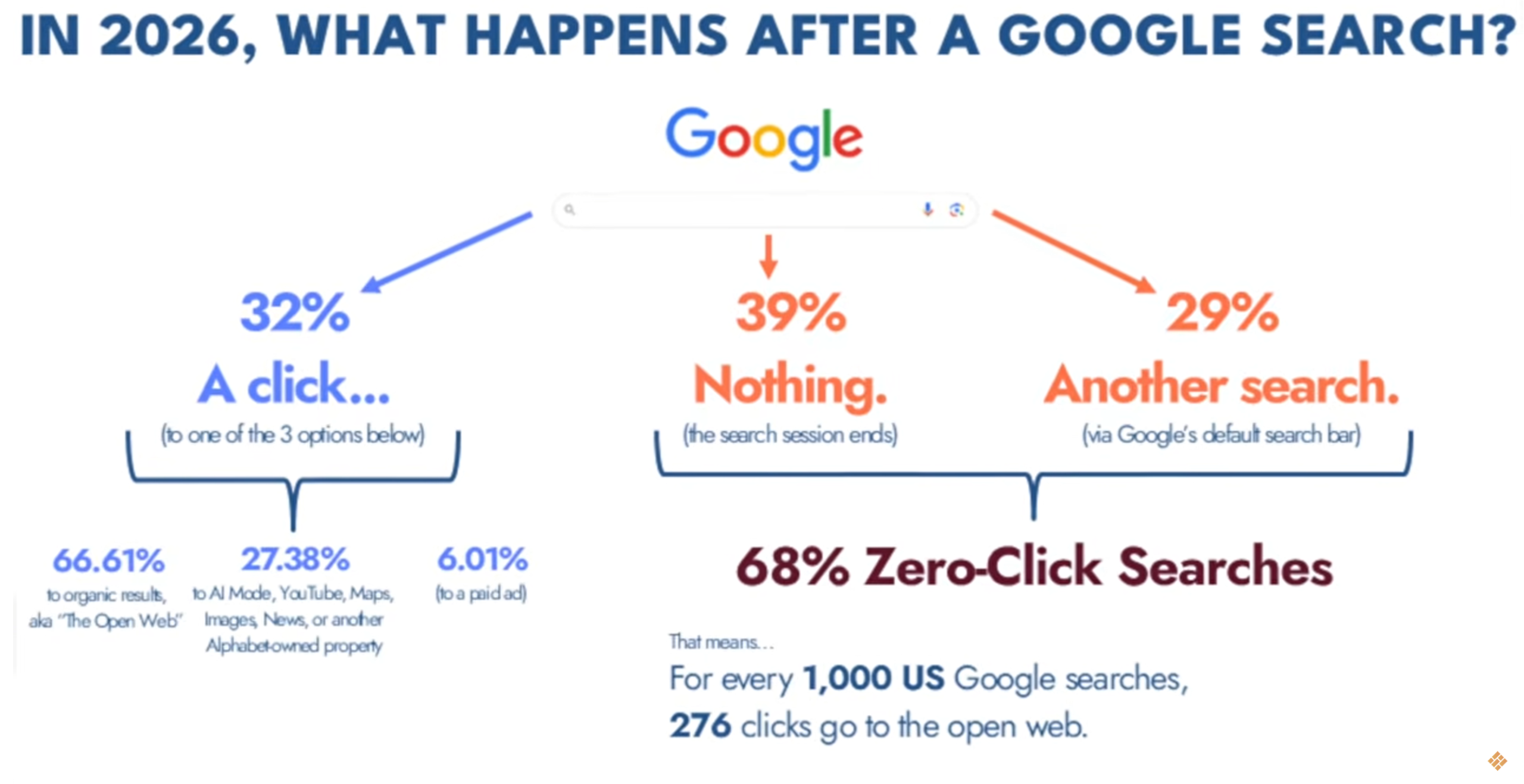
In the first four months of 2026, 68% of US Google searches ended without anyone clicking through to a website.
Not your website.
Any website.
Let that sink in for a second. For every 1,000 searches people run on Google, only 276 of those clicks make it out to the open web. The rest either find what they need right there on the results page, give up, or fire off another search without ever leaving Google.
We’ve been telling Perth clients for a while now that the ground under search has been moving. This is the clearest picture yet of where it has landed.
What actually happens after someone hits search
SparkToro broke down what a single Google search leads to, and the split is telling:
- 32% end in a click to something
- 39% end in nothing. The person got their answer, or didn’t, and the session ended
- 29% lead to another search through Google’s own search bar
So most searches don’t send anyone anywhere outside Google. And of the third that do produce a click, here is where those clicks land:
- 66.61% go to organic results, the open web, real websites
- 27.38% go to Google’s own backyard: AI Mode, YouTube, Maps, Images, News and other Alphabet-owned properties
- 6.01% go to paid ads
There’s a lot buried in those figures, so let me pull out the part that matters most.
The good news hiding inside the bad news
Yes, the pie is smaller. Fewer searches send a click anywhere than they did even two years ago. The zero-click rate sat at 60.45% in 2024, so it has climbed more than seven points in just two years.
But look again at where the clicks that do happen end up. Two out of every three land on organic results. Not ads. Not YouTube. Plain organic listings on real websites. Paid ads pick up a touch over 6% of clicks, which is worth remembering next time someone tells you to tip your whole budget into Google Ads.
If your business is going to fight for any slice of search traffic, organic is still the biggest slice on the table. SEO didn’t die. The rules just got a lot stricter about who gets in.
Why is this happening?
Two words keep coming up: AI Overviews.
Those AI-generated summaries now sit at the top of more than one in five Google searches, and when they appear, click-through rates fall by close to 60%. Google reads the page for the searcher and hands over an answer, so they never need to visit the site that wrote it.
Then there’s AI Mode, Google’s full chat-style search. During the SparkToro study it only picked up 0.34% of searches, which sounds tiny. But here’s the catch. Google said at its I/O event this year that AI Mode had passed a billion monthly users, with query volume more than doubling every quarter. That 0.34% is not going to stay small for long.
The honest read on all this: Google is quietly turning itself into a walled garden. It wants to answer your question and keep you inside, not send you off to someone else’s site.
So where does that leave a Perth business?
I’ll be straight with you. There’s no clever trick that makes this go away. But the work that wins from here is mostly the work good SEO has always rewarded, so let me walk through what we’d actually focus on.
Start with the searches people can’t resolve without you. This is the bit AI summaries can’t touch: a real problem that needs a real person. Someone typing “litigation lawyers Perth” at 11pm isn’t after a tidy paragraph at the top of the page. They’ve got a dispute on their hands and they need to ring someone. That click is still very much up for grabs.
We’ve watched this play out first-hand. Robertson Hayles Lawyers, a Perth firm going back to 1965, came to us with decades of reputation and almost no online visibility. So we went after the exact searches their future clients were actually typing: the urgent ones like “litigation lawyers Perth”, the planning ones like “probate lawyers Perth”, and the broad ones like “lawyers Perth”. Over the campaign, “litigation lawyers Perth” climbed from position 20 to 2. “Probate lawyers Perth” went from 10 to 2. Organic traffic grew 189%, and their director, Kevin de Souza, told us they were “tracking very well on Google for searches”.
Not one of those is a search an AI Overview can finish for the searcher. You can’t settle a legal stoush with a summary box. That’s the kind of intent still worth every dollar, and it’s where I’d point your budget first. The “what is grout” style of informational query is the stuff getting swallowed whole. “Emergency electrician Joondalup” is not.
The next move is to become the source the AI quotes. Those Overviews have to pull their answers from somewhere, and if your content is clear, properly structured and genuinely useful, it can be your site getting credited in the summary. Even when the searcher doesn’t click, your name is the one sitting in front of them.
Then there’s your brand itself. Remember that 29% who run a second search? A fair chunk of those are people typing in a business name they already know. The more locals recognise your name, the more they go looking for you on purpose, and a branded search is about as warm a lead as you’ll find. Brand recognition is quietly becoming its own form of SEO.
And finally, stop treating organic and Google Ads as the same bet. Ads take 6% of clicks. Organic takes two-thirds. That doesn’t mean drop paid search altogether, but it does mean the maths of where your money works hardest has changed.
Where this leaves us
I’m not going to pretend it’s all rosy. Watching your traffic graph slope downward is no fun, and a lot of that has nothing to do with anything you did wrong. Google changed the deal.
But the businesses that win from here are the ones that stop chasing easy clicks and start earning the hard ones. The searches where a real person genuinely needs a real website. Those clicks still exist. There are 276 of them in every thousand searches, and most of them go to organic results.
The real question isn’t whether SEO still works. It’s whether your site is good enough to be one of the 276.
If you want a straight answer on where your Perth business sits in all of this, that’s the sort of thing we do every day. Give us a yell.
Data from SparkToro’s June 2026 zero-click search study, based on Similarweb clickstream data. Robertson Hayles Lawyers results from our own client campaign.