
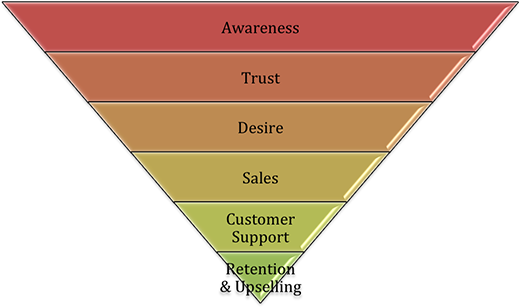
Funnels and Why They Are So Effective
If you keep a keen eye on online marketing, SEO, and website development, you must surely have come across the term 'funnel' in a blog post, article, or even an online ad.
If you have never heard the term, we'll explain what they are compared to normal websites. For those who have come across funnels, we will explain further why they are going to play an ever-increasing role for local businesses as part of their online marketing strategies.

How SEO Can Help Small Businesses Compete on Google Search
It is an obvious fact that small businesses do not have the financial resources of large national and international companies and that means that their marketing budgets are going to be much smaller too. This might suggest that the chances of smaller businesses being able to compete on Google for search traffic are slim, but thanks to SEO, that is not the case.
The first fact we need to outline is that when it comes to Google's ranking algorithms it does not know how big a company is, how much profit it makes or how big its marketing budget is. When crawling that company's website and analysing everything else that contributes to ranking the currency isn't cents and dollars, it is links and optimisation.
Why Your SEO Must Include Google’s Keyword Order of Importance
If you have researched SEO in any way, you will have undoubtedly discovered a lot of discussions about keywords. Keywords and their importance to SEO have had many business owners scratching their heads, wondering how they work.
Even to those with a modicum of marketing knowledge, keywords can be a source of huge frustration as they try to work out which ones to optimise for and where to have those keywords positioned on their website or on other websites in links back to theirs.

5 Ways To Make Your Content SEO Friendly
If there is one aspect of SEO upon which more content is written than any other, then, ironically, it is content. Ironically is probably the wrong word to use as ‘Justifiably’ would have been more appropriate, given how important content is to SEO and helping websites rank.
One reason so much is written about content is because it is a very effective way, and in most cases, a straightforward way, of enhancing a website’s SEO, especially in the eyes of Google.
However, its perceived easiness is the main reason why so many business owners get it entirely wrong when they create or purchase content for their websites.

Do I Need To Optimise My WordPress Site For Voice Search?
Google Voice search is one of the fastest-growing web technologies at the moment. It involves people asking their phone a question and receiving one single answer, rather than the traditional list of results that are presented on a normal search engine results page.
One of the main reasons for the increase in the popularity of voice search is the rapidly improving ability of artificial intelligence to recognise human speech and infer meaning. And since speaking is a lot easier than typing, people have begun to adopt the technology. With this in mind, voice search optimisation has become a key feature of most experienced web developers’ toolkits.
Which Is Better For SEO HTML Or WordPress?
There are certain comparisons that are made where the evidence provided by data, does not match what the majority of those with an opinion will tell you. A classic example is when people ask whether HTML or WordPress is better for SEO. Let us say from the outset that most of the empirical data and statistics indicate that neither HTML nor WordPress has an advantage over the other when it comes to SEO.
Now we must clarify what we mean by an advantage. What we are talking about here is whether sites built using WordPress, for example, will rank higher than a site built with HTML, when all other factors are equal. The fact of the matter is that Google doesn't place any great emphasis on what a website is built from when it comes to ranking them.
To confirm this, do a random search on Google and click through to each of the top ten websites. For each one, if you then press CTRL+U on your keyboard the source code will appear. Using the find function in your browser type in 'wp-content'. If the search finds that in the code it is a WordPress site, and if not then it could be either a HTML site or one built using another less popular Content Management System (CMS).

Does Hiding Your WHOIS Details Hurt Your Website’s SEO Ranking?
Whenever you register a domain name, details such as your name and address and the date of registration are held by an organisation called ICANN. If someone wants to determine who owns a website, they conduct a WHOIS search which will tell them. For privacy reasons, many web owners hide these details, but this raises the question as to whether this will negatively impact your SEO rankings.
To address this, we need to understand what Google’s entire ranking algorithm is designed to achieve. Google can only survive if web users continue to use it as a search engine. This means that the results that Google presents for any given search term need to be relevant and show websites that the user would be happy to visit.
The degree to which Google establishes whether any single website is worthy of showing up in its results is established by taking multiple factors in to consideration. For each of these, Google’s algorithms then apply a score to that site based on what it considers to be a positive or negative indicator.
When it comes to your WHOIS details there may be many valid reasons why you would want to keep your details private. It could be that you want to avoid your employer discovering that you are running a website. Another might be to avoid strangers knowing your home address. Whilst these are perfectly reasonable, unfortunately, Google knows private WHOIS registration is something that potential spammers use, and this is where it could impact your ranking.

What are Long Tail Keywords?
What are Long Tail Keywords and how can you use them for your SEO?
If you have been looking for information on SEO and SEO companies, you may have come across the term ‘Long Tail Keywords’ and wondered what it meant. Well, long-tail is nothing to do with furry animals but is in fact, an SEO technique that, if used correctly, can help to generate increased traffic to websites and other online properties.
At the core of long-tail SEO are Long Tail Keywords, which are keywords that contain more than two words. You won’t be surprised to know that keywords with only one or two words are called short-tail keywords. Examples of short-tail keywords in the dog niche would be ‘kennel’ and ‘dog grooming’, and in the technology niche, ‘laptop’ and ‘computer keyboard’.
If a website owner were to try and rank for any of those keywords, they would be competing against tens of thousands of other websites, and many of them will be websites owned by some of the biggest online companies in the world. It is safe to say that most local marketing budgets are not going to be able to compete with the likes of companies whose SEO budget is almost unlimited.
So, how can you compete online and get traffic to your website? Well, the answer is long-tail SEO, and employing any number of Long Tail Keywords that you can rank for. A key point to note is that your competition online isn’t the Amazon of this world, it is the websites owned by other companies operating in your niche or market, and who do so within your local area.

Is Wix Or WordPress Better For SEO?
Regardless of what technologies, apps, or software there exist on the internet, there are always going to be competitors. Often this leads fans of each to sing their praises, and then those who wish to know more, asking which they should use. This leads invariably to articles such as this where we try to determine which is best. The difference here is that we are comparing Wix and WordPress within a very specific criterion, and that is SEO.
It may help many of you if we briefly explain what Wix and WordPress are and what they are primarily designed to do. If we start with Wix, it is an all-in-one website builder, and it is especially popular with newbies and those for whom website code brings them out in a cold sweat. With Wix you can have your website built very quickly using its pre-designed website temples, it has built-in security, and important for many, it has its own in-house support staff.
WordPress is an open-source content management system which can be used to create hosted websites. It has a bigger learning curve than Wix, but this also means it has much greater scope for flexibility. This means websites can be built with a raft of customisations and thousands of plugins to add greater functionality in both the front end and back end of sites built using WordPress.
When it comes to SEO there is one thing which Wix and WordPress both have in common, and that is their great reliance on third-party software. This will be apps in the case of Wix, and plugins for WordPress. There are several apps which Wix uses for SEO, with one of the most popular called 'Site Booster'. Site Booster has both a free and premium version and as with most SEO apps it is only the paid one which gives you all the functions that you need to boost your website's SEO

Ways to Boost the Domain Authority of Your Website
Domain Authority falls under the category of Off-page SEO metrics.
It's a predictive ranking score developed by Moz that estimates how likely a website is to rank in search engine results pages (SERPs).
While not an official Google ranking factor, it's considered part of off-page SEO because it primarily measures external factors like:
- The quantity and quality of backlinks pointing to your domain
- The authority of the sites linking to you
- The overall link profile of your website
Unlike on-page SEO factors (which focus on content optimization and technical elements within your website), Domain Authority looks at external signals that indicate your site's reputation and trustworthiness across the broader internet ecosystem.